
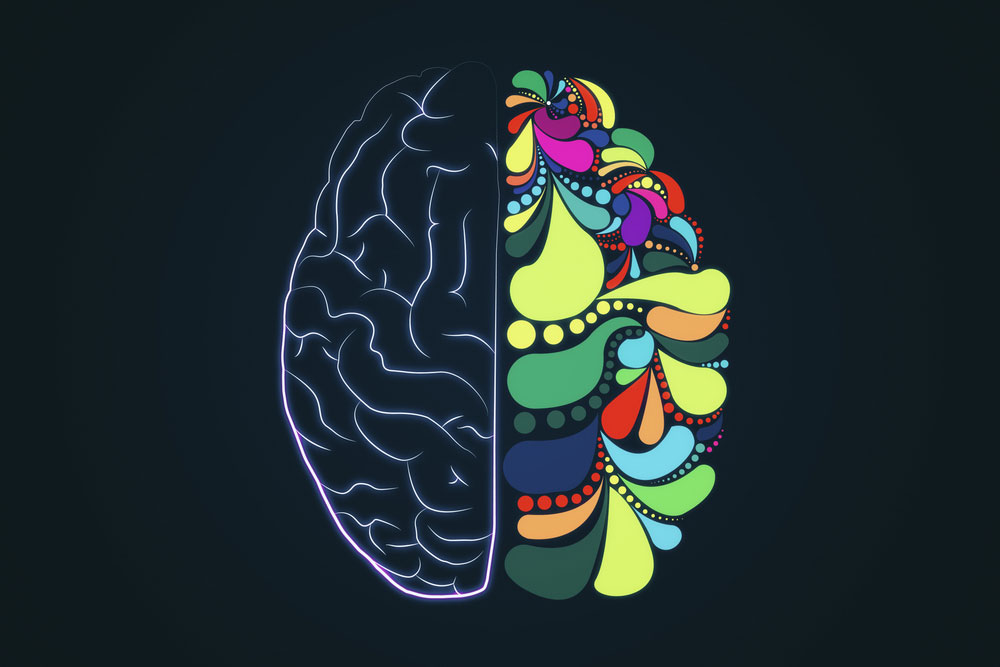
There are people walking around right now whose brains have been surgically split in half. And what researchers discovered when they studied these patients revealed something fascinating about how all of our minds work.
Why Would Anyone Split a Brain?
Starting in the 1940s, surgeons began performing a procedure called a corpus callosotomy on patients with severe, medication-resistant epilepsy. The corpus callosum is the brain’s largest nerve tract ,which connects the left and right hemispheres. When a seizure starts on one side, it can travel through this connection and spread to the other, resulting in a dangerous generalized seizure. Cutting the connection stops that spread.
The surgery worked. But it also meant the two hemispheres could no longer directly communicate — and that opened the door to some of the most revealing experiments in the history of neuroscience.
How Do You Talk to One Hemisphere at a Time?
This is the result of a peculiar way humans’ vision system works. Your vision is split down the middle: everything in your left visual field goes to your right hemisphere, and everything on the right goes to your left. Normally the corpus callosum shares this instantly. In a split-brain patient, that transfer can’t happen.
This matters because language lives almost exclusively in the left hemisphere. The left hemisphere can tell you what it saw. The right hemisphere understands what it saw but can’t speak, it can only respond through actions like pointing or drawing with the left hand.
By flashing images to one side while patients fixated on a center point, researchers could send information to one hemisphere without the other ever knowing.
The Discovery That Took 25 Years
Neuroscientist Michael Gazzaniga began studying split-brain patients in Roger Sperry’s lab at Caltech in the early 1960s. Sperry received the 1981 Nobel Prize for this work. For 25 years, the experiments focused on demonstrating that the two hemispheres had different specializations and could operate independently.
Then Gazzaniga and his colleague Joseph LeDoux stumbled onto something nobody expected.
A patient was shown two images simultaneously: a chicken claw to the left hemisphere and a snow scene to the right. The hemispheres couldn’t share this information. Researchers placed pictures on the table and asked the patient to point to something related to what he saw. His right hand pointed to a chicken. His left hand pointed to a snow shovel. Both made perfect sense.
Then they asked: “Why did you pick the shovel?”
The left hemisphere — the side that talks — never saw the snow scene. The correct answer would be “I don’t know.”
However, without hesitating, the patient said: “The chicken claw goes with the chicken, and you need a shovel to clean out the chicken shed.”
He made it up. Instantly. Seamlessly. And he completely believed it.
The Interpreter
Gazzaniga named this the “left-brain interpreter.” It’s a system that generates explanations for your behavior in real time. First published in Gazzaniga and LeDoux’s 1978 book The Integrated Mind.
Across dozens of patients, over decades of testing, the interpreter never said, “I don’t know.” It always produced a reason. The reason is plausible, confident, and sometimes completely fabricated. In one experiment, the word “walk” was flashed to the right hemisphere. The patient stood up. Asked why: “I’m going to get a Coke.”
Every time, the speaking hemisphere (left) observed an action it didn’t initiate and constructed a story rather than admitting ignorance.
This Isn’t Just a Split-Brain Phenomenon
The interpreter isn’t an artifact of a rare surgical condition. It’s a feature of normal human cognition. The split-brain experiments just made it visible.
In an intact brain, the interpreter has more information to work with, so its stories are more plausible and harder to catch. But “more plausible” doesn’t mean “accurate.” The interpreter’s job isn’t truth. It’s coherence.
What the Popular Accounts Get Wrong
The most common exaggeration is that splitting the brain creates “two separate people” inside one skull. But in 2017, Yair Pinto and colleagues published a study in Brain challenging this view. They found that split-brain patients could still respond to stimuli in either visual field with either hand — something that shouldn’t be possible if the hemispheres were truly isolated conscious agents. Their alternative: split perception but unified consciousness.
Another common overclaim is that “consciousness is an illusion.” The interpreter research doesn’t support this. What it shows is that our explanations for our behavior are often constructed after the fact. You are genuinely experiencing things. You’re just not always right about why.
Why This Matters in the Therapy Room
A significant part of therapy involves examining the stories people tell about their own behavior. “I drink because I’m stressed.” “I snapped at my partner because they were being unreasonable.” These explanations feel like insight. Sometimes they are. But the interpreter research tells us that the feeling of knowing why you did something is identical whether the explanation is accurate or fabricated. You can’t tell the difference from the inside.
This isn’t a flaw. Gazzaniga has argued the interpreter is evolutionarily adaptive; a species that asks “why did that happen?” understands its environment better than one that doesn’t. But it means our first-person accounts of our own motivations are unreliable narrators.
This is may be one reason for why therapy works. Not because a therapist is smarter than you. But because you cannot catch your own interpreter in the act. Sometimes you need someone outside your own head to test the story.
The split-brain experiments didn’t create the interpreter. They made it visible.
I made a short video walking through the key experiment and what it means.
Matt Christian, LCSW, LSATP
Executive Director, Insight Into Action Therapy
References
Gazzaniga, M. S., & LeDoux, J. E. (1978). The Integrated Mind. Plenum Press.
Gazzaniga, M. S. (2011). Who’s in Charge? Free Will and the Science of the Brain. Ecco/HarperCollins.
Johansson, P., Hall, L., Sikström, S., & Olsson, A. (2005). Failure to detect mismatches between intention and outcome in a simple decision task. Science, 310(5745), 116–119.
Nisbett, R. E., & Wilson, T. D. (1977). Telling more than we can know: Verbal reports on mental processes. Psychological Review, 84(3), 231–259.
Pinto, Y., et al. (2017). Split brain: Divided perception but undivided consciousness. Brain, 140(5), 1231–1237.
Sperry, R. W. (1968). Hemisphere deconnection and unity in conscious awareness. American Psychologist, 23(10), 723–733.